Spend enough evenings on Lake Lanier and someone will tell you a story. A woman in a blue dress, seen on the bridge. Hands that tug at swimmers. A lantern moving across water far too deep to pole.
Lanier may be the most storied lake in Georgia. Here are the legends the way locals tell them, and what the record actually says underneath them. Keeping those two straight is the whole point.
You're searching for…
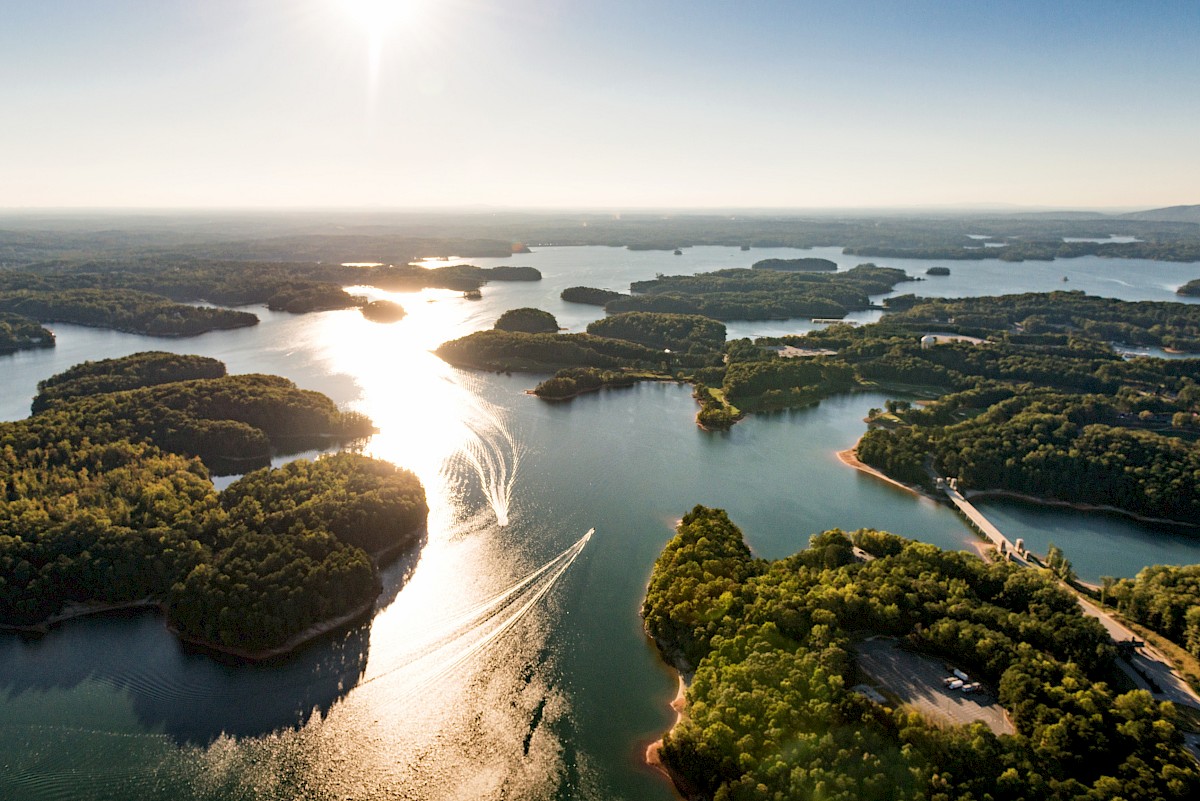
Lake Lanier is not a natural lake. The U.S. Army Corps of Engineers built Buford Dam across the Chattahoochee River in the 1950s for flood control, power, water supply and recreation. The dam gates closed on February 1, 1956, and the water rose slowly, reaching full pool by the end of the decade.
The full name is Lake Sidney Lanier, for the Georgia poet who wrote "Song of the Chattahoochee." At full pool it covers 38,000 acres with 692 miles of shoreline, runs about 160 feet deep at the dam, and draws roughly 10 million visitors a year.
This one starts with a real tragedy. In April 1958, friends Delia May Parker Young and Susie Roberts left a dance in Dawsonville and drove toward the lake. Their car went off Lanier Bridge and vanished. Searchers found neither the women nor the car. About a year later, a fisherman found a body in a blue dress floating near a bridge, missing both hands and too decomposed to identify. It was buried unnamed.
The story rested there for more than three decades. Then, in November 1990, crews dredging for the new Lanier Bridge found a 1950s Ford in about 90 feet of water. The remains inside were matched to Susie Roberts, and authorities concluded the 1959 body must have been Delia's.
The story people tell is that she had been seen all along: a woman in a blue dress wandering the bridge, searching for her hands, and in the scarier versions, reaching toward swimmers. She is the "Lady of the Lake." One honest note: most accounts identify her as Delia, at least one local account says Susie, and the identity was never settled. That is part of why the story endures.

The man on the raft. Late-night boaters tell of a shadowy figure poling a raft across the lake, a single lantern hanging from a pole, in water said to be 45 to 50 feet deep, far too deep for any pole to reach bottom. In the best-known version, two fishermen watched him dive in and swim toward them. When they turned back, raft, man and lantern were gone. Believers read him as an echo of the Chattahoochee's old river ferrymen.
Hands in the water. Swimmers are said to report hands pulling them down, or an invisible force dragging them toward the bottom. Divers working in near-zero visibility tell their own version. Long-time diver Buck Buchannon described it in 2017: "You reach out into the dark and you feel an arm or a leg and it doesn't move."
The church bell. Other tellings include a church bell still ringing underwater, voices beneath the surface, and catfish "as big as a Volkswagen." The bell, at least, has an official answer. Corps spokesman Cesar Yabor noted there is no sunken church left standing tall enough for that, and bells would have been removed before the flooding. Tell the story, by all means. Then give that answer.
The basin was rural farmland and woodland: farms, homes, churches and mills, not incorporated cities. The government bought more than 56,000 acres, and everyone moved out before the water rose. Gwinnett County's history counts 250 families, 20 cemeteries, 15 businesses and six churches moved, and the Corps' own manual gives a basin-wide figure of more than 700 families. Being bought out under eminent domain was a real loss for families who had farmed that land for generations, but it was an orderly one. Nobody was flooded out alive.
Oscarville, carefully. This small farming community in northeastern Forsyth County sits at the center of the most distorted Lanier story. The Atlanta History Center corrects the viral version on two points: Oscarville was a predominantly white town, and its people were not killed or driven out by floodwater. The land was vacated long before the lake filled. What actually happened is darker, and it happened in 1912, not 1956. After 18-year-old Mae Crow was found beaten near Oscarville and later died, Rob Edwards was lynched, two teenagers were convicted by an all-white jury and executed, and night riders burned Black homes and churches. In about three months, more than 1,000 Black residents were forcibly displaced from Forsyth County. Part of the Oscarville site is under Lanier today, but its Black community was destroyed by racial terror four decades before the lake, not by the Corps.
And the graves? Marked, known graves were not simply left behind. Twenty cemeteries were relocated, with hundreds of burials exhumed and reinterred, including 97 graves at Spencer Hill Baptist Church, a Black congregation in Hall County, moved in consultation with descendants. The Corps adds an honest caveat: 1950s methods probably missed unmarked burials, so remains nobody knew about may still be down there. Nobody can say how many.
What is actually down there is not an intact underwater town. Divers and sonar document road beds, including a stretch of old Georgia Highway 53, home foundations, bridge remains, tree stumps, and the concrete grandstands of Looper Speedway, a dirt track that closed as the water rose. In December 2007 the lake fell to a record low of 1,050.79 feet, about 20 feet below full pool, and the drought exposed all of it to daylight. Every drought since has done the same: shown people something real down there, and started a fresh round of ghost stories.
People keep dying at Lanier, and that part is real, which is exactly why the curse story sticks. Georgia DNR counted 216 deaths between 1994 and 2022, in drownings and boating fatalities. A figure of "as many as 700" since the lake was created circulates widely, but no official body publishes a since-1956 total, so treat it as an unverified popular estimate.
Officials point to ordinary, documented causes: boating under the influence (109 instances recorded at the lake in 2022 alone, alongside 6 drownings and 19 injuries), crowded water, submerged trees and foundations, sudden deep water, and dark, murky depths. As USA Today put it in 2026, despite the toll, "the water itself is not dangerous." The real dangers are ones you can do something about:
These stories are best told the way they started: on the water, at anchor, as the light goes. Nautical Boat Club – Lanier Islands runs out of the Margaritaville Lakefront complex in Buford. The dock team is on this water every day, the boat is fueled and ready before you arrive, and an evening cruise past Buford Dam and some of Lanier's more than 100 islands is the finest seat in Georgia for a ghost story.
"We have been Club Members for two seasons and Nautical is the best boat club on Lake Lanier. Each time we arrive, someone greets us at our car and helps us carry our gear to the boat. … We typically go out on weekday afternoons and boats are always available."
— Kevin Burke, Nautical Boat Club – Lanier Islands (Lake Lanier) (Google Review, 5★)

A well-equipped tri-toon or bowrider runs $45,000 to $80,000 new. Add a slip billed every month, insurance at $1,000 to $2,500 a year, winterization, and depreciation of 10 to 20 percent in year one, and ownership commonly lands at $9,000 to $15,000 a year. Membership runs a one-time $3,000 to $8,000 initiation and $300 to $600 a month, with the fleet, slip and maintenance carried by the club. The full breakdown is in our 2026 membership cost guide.
If you live on Lanier with a deep-water dock, or fish a rig you have spent years setting up, owning is the better fit, and we would rather say so now. A club is for everyone who wants the lake, and its stories, without the slip, the gauge and the maintenance schedule.
See Nautical Boat Club – Lanier Islands, call (470) 222-2628, or read our guide to boating Lake Lanier.
The first & only Boating Country Club®
U.S. Army Corps of Engineers, Lake Sidney Lanier and the Buford Dam water control manual · Gwinnett County, History of Lake Lanier · Atlanta History Center, Forsyth 1912 project · Lake Sidney Lanier Memories, Land Acquisitions and Relocations · USA Today, October 6, 2026 · Oxford American, Summer 2021 · Georgia DNR fatality counts, 1994–2022, via the Gainesville Times